Energy storage modeller · BESS and hybrid plants
Size utility-scale BESS from cell to point of interconnection
Ampyra ESM models standalone BESS and hybrid PV, wind and BESS plants on the data OEMs actually provide. Every loss stage, every year of life, every input visible in Excel.
Every stage is modelled at every time step and rebuilt monthly as the battery ages.
Why Ampyra
Bid-grade BESS sizing needs a model you can audit
Built on OEM data
OEMs share container data, not cell data. OEM data mode runs on what suppliers provide: degradation by P-rate, DC RTE by year, PCS and transformer efficiency, aux tables from 0 to 55 °C.
Tested at the POI
Guarantees are measured at the point of interconnection, so the contracted capacity is tested there at the start or end of every year of life.
No black boxes
A documented method. Every parameter is a visible Excel input, every result is traceable, and the energy balance closes in every run.
Capabilities
Everything a storage bid has to prove
Degradation & efficiency
Cell physics or OEM data
- Cell model: rainflow counting, calendar and cycle ageing with temperature, SoC and C-rate effects
- OEM mode: ageing from cycling and calendar time using the OEM’s own warranty data
- FAT-to-SAT retention, ageing tracked per augmentation cohort
Dispatch
Four modes, one engine
- Standard daily cycles, your own time series, contracted monthly cycles
- Round-the-clock supply from PV, wind and BESS against yearly CUF targets
- Simulation steps from 5 to 60 minutes
Hybrid plants
PV, wind and BESS on the same footing
- AC, LVAC, DC, Reverse DC and Dual DC coupling, with partial BESS coupling
- Wind at the MV bus; PV profile library for tracker and fixed designs
- Clipping loss optimisation, even with BESS charging priority
Sizing & augmentation
Minimum build that passes every year
- PCS count at design ambient, fewest containers that meet the POI test over life
- Augmentation every year, every 3 or 5 years or custom, with a fixed cost per event
- BoL overbuild compared with augmentation, discounted to COD
Contracts & timelines
Contract terms modelled as written
- SSA contracted capacity with Min / Max MWh milestones and an optimiser for hold periods
- Time-of-use tariff weighting and annual CUF targets
- Date-based years with up to three ICOD phases before COD
Economics & climate
LCOS, LCOE and hot-climate aux
- LCOS for standalone BESS, LCOE for hybrids, cost-optimal PV × wind × BESS search
- Four ambient profiles, temperature derating of PCS and PV inverters
- Container aux in operation and standby, scaled with load
Comparison engines
Compare options like for like, in one run
Each engine writes one workbook with the best values highlighted, PASS / FAIL flagged and year-by-year charts.
OEMs
Each OEM auto-sized to pass every year, ranked by installed MWh or LCOS / LCOE.
compareCases
Ambient profile × augmentation × aux scaling.
casesCouplings
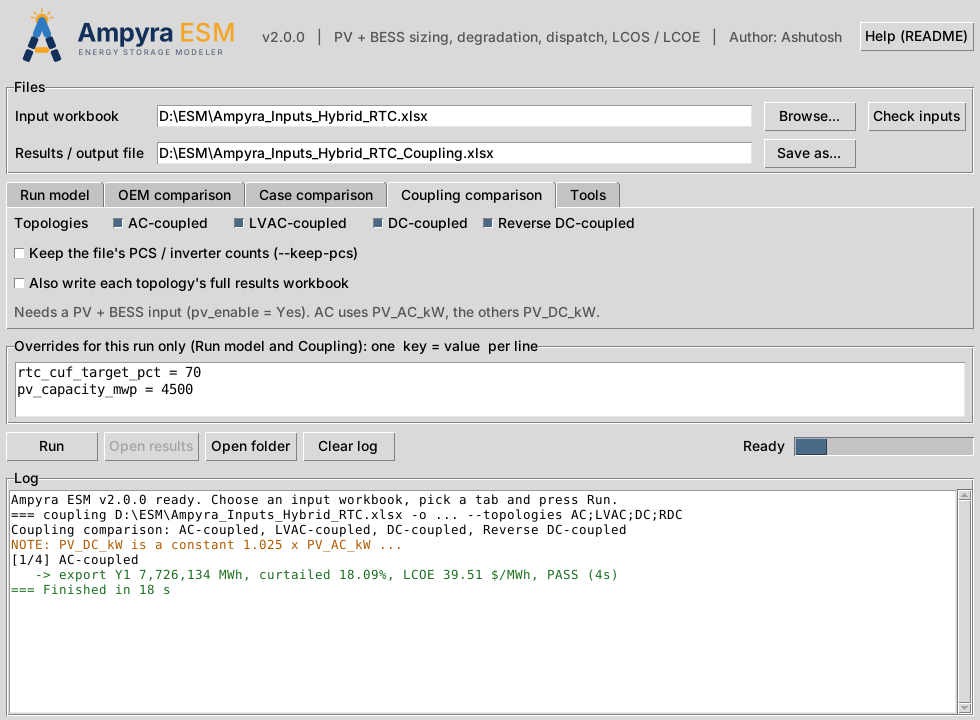
All five topologies from one PV + BESS file.
couplingPV profiles
Tracker vs fixed, each re-sized with its own MWp and cost.
pvprofilesAugmentation
Every year, every 3 or 5 years, or custom.
augcompareSSA contract
Hold-at-Max periods × augmentation, best LCOS.
contractClipping
The same plant with and without clipping loss optimisation.
chargeshapeCycle sweep
Monthly RTE against cycles per month.
cycles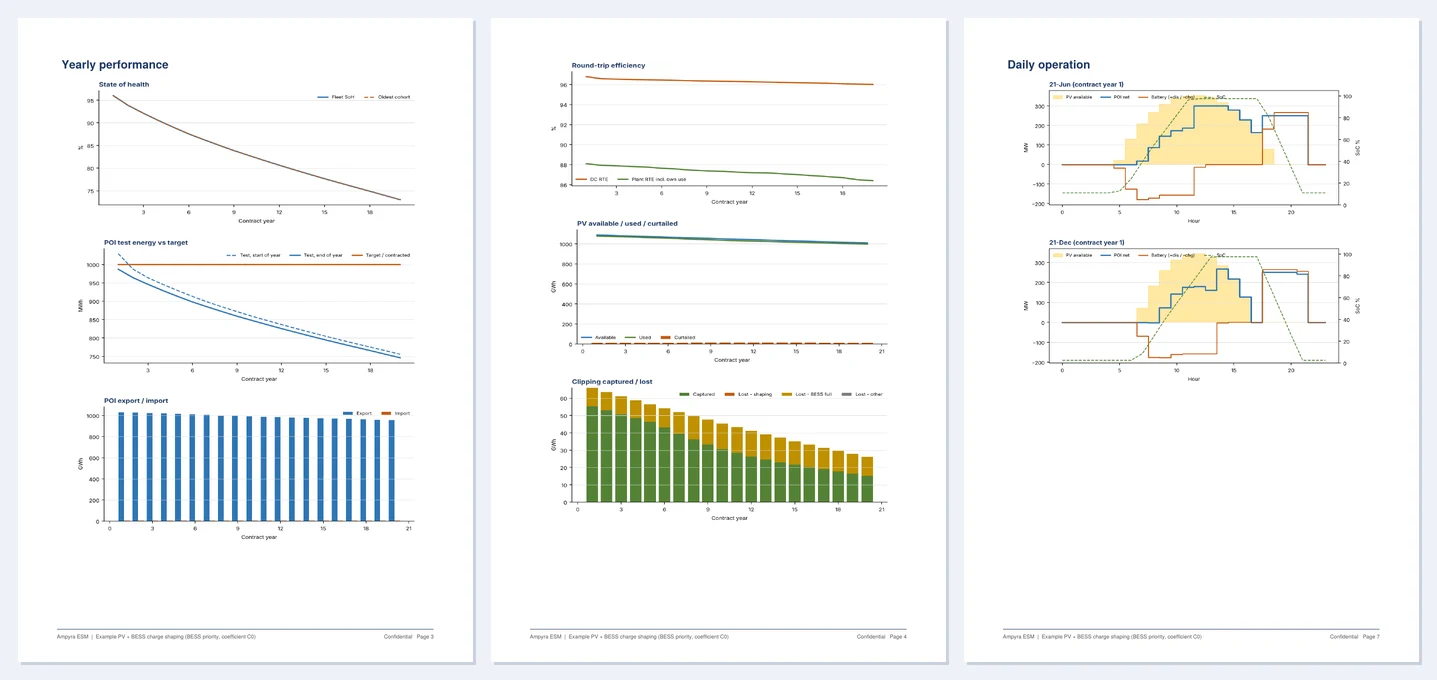
Outputs & reporting
Excel in, Excel out, and a report your client can read
Results workbook
Summary, yearly and monthly results, losses by stage, financials and every input used.
Full-life hourly data
175,200 rows for a 20-year project; hourly sums match the yearly sheet.
PDF report
Your logo, colours, sections, KPIs and charts, rebuilt any time without re-simulating.
The software
One engine, two ways to run it
Windows desktop app
No Python needed. A tab for every run and comparison, an input check before running, and a Results Explorer for day, week and month charts.
Command line and Python
The same engine for batch runs and scripting.
ampyra run Project.xlsx -o Results.xlsx
Overrides and upgrades
Change any parameter per run without editing Excel; older input files upgrade with every value kept.
Services
Modelling and advisory for PV + BESS projects
Use the software yourself, or have the modelling done for you by an engineer who works on Gulf utility-scale storage bids.
Bid sizing
BESS and hybrid sizing against the tender’s POI capacity, cycle and availability terms.
OEM evaluation
Like-for-like comparison of OEM offers: containers needed vs offered, margins, LCOS.
Augmentation & SSA strategy
When to augment, how much, and how long to hold the maximum contracted capacity.
Software licence
The desktop app and Python package, with templates and the full model manual.
Scope. Financials are pre-tax and unlevered, for technology and sizing comparison. Results depend on the OEM and site data you enter; shipped templates hold placeholder values.
Contact
Let’s model your next BESS or PV + BESS project
A demo on your own OEM and site data is the best place to start.